Archive for the ‘Science’ Category

Episode 73 – Mysterious 12,000-Years-Old Gobekli Tepe, Turkey

Play

Episode 73 - Mysterious 12,000-Years-Old Gobekli Tepe, TurkeyEarthfiles Reporter and Editor Linda Moulton Howe interviewed Robert M. Schoch, Ph.D., Geologist, Boston University, inside the Gobekli Tepe, Turkey, excavation site on June 13, 2012. The T-shaped pillars have an anthropomorphic identity. But who are they? As their faces are never depicted, they seem very likely to be related to supernatural beings, beings gathered at Gobekli Tepe for certain, but so far unknown, purposes.

Episode 66 – Supernovae and Gamma-Ray Bursts

Play

Episode 66 Supernovae and Gamma-Ray Bursts The January 5, 2010, issue of Scientific American, headlined an article about a “Supernova star too close for comfort” to Earth. Since our solar system is in the Milky Way galaxy filled with potential supernovae and even much bigger gamma-ray bursts from much larger dying star deaths, could we be hit by a blast of gamma rays large enough to knock out our ozone layer? If that happened, all surface Earth life, including humans, would be exposed to deadly UV and gamma ray energies no longer blocked by the protective ozone layer. Has that happened before to our planet and caused one or more of the half dozen extinction events that mark life and death evolution on Earth?

Episode 65 – Life Saving Miracles – Angelic Interventions?

Play

Episode 65 Life Saving Miracles - Angelic Interventions? Earthfiles Reporter and Editor Linda Moulton Howe has encountered mortal danger several times and Something in the unseen has intervened to save her life. Does the soul/spirit call out? Is there another-dimensional physics of angelic interventions, a very real dynamic of our cosmos that many have experienced through the centuries, but still remains a spiritual mystery, a miracle?

Episode 60 – Life On Europa?

Play

Episode 60 Life On Europa? Jupiter’s moon, Europa, is nearly as large as Earth’s moon and beneath its icy surface is a liquid water ocean 100 miles deep that has oxygen. There in all that water University of Arizona Planetary Scientist Richard Greenberg thinks life already exists.


Episode 59 – 25% of H1N1 U.S. Patients Sick Enough To Be Hospitalized End Up in ICU

Episode 59 25% of H1N1 U.S. Patients Sick Enough To Be Hospitalized End Up in ICUSurprising October 2009 news from Centers for Disease Control is that this past spring, 7% of Americans sick enough to be hospitalized with the novel H1N1 flu, have died. That 7% is a higher mortality rate than ordinary seasonal flu. How many Americans ended up in intensive care with the new H1N1 virus? 25%. These statistics provoked Dr. William Schaffner, a Vanderbilt University flu expert, to warn: Contrary to the perception among many people that this influenza, the novel H1N1, is mild, these data vividly demonstrate that this influenza can make you very, very ill.


Episode 49 – Is 2009A/H1N1 Outbreak A Herald Wave?

Play

Episode 49 - Is 2009A/H1N1 Outbreak A Herald Wave? Dr. Paul Glezen, M. D., Molecular Virologist at Baylor College of Medicine in Houston, has published data that shows there were short herald waves of influenza virus outbreaks before the 1918 Spanish flu, the 1957 – 1958 Asian flu and the 1968 Hong Kong flu.This week I asked him if he thinks the 2009 A/H1N1 could be a herald wave of a much more serious flu epidemic upcoming in Fall 2009.

episode 49 image


Episode 40 – Silicas – and Hot Springs – On Mars

Play

Episode 40 - Silicas - and Hot Springs - On MarsA long-standing question in Mars research has been: Did volcanic Mars have hot springs? If so, was there life? Astrobiologists now report possible hot spring sites in Arabia Terra and the Gusev crater region where the Spirit rover found almost pure silica in 2008, a sure sign of hot water moving over rocks.

episode 40 image


Episode 39 – Trends Journal Forecasts 2009 Economic Depression

Play

Episode 39 - Trends Journal Forecasts 2009 Economic DepressionThere were unsettling eyewitness reports in the 14th Century from China to Europe of bright lights in the skies that emitted “mists” and foul-smelling ground fogs associated with figures in dark cloaks waving “scythes” during “The Black Death” in which nearly half of the European population died from plague.

episode 39 image

Episode 29 – Carbon Dioxide Build-Up in Oceans Will Kill Off Coral Reefs by 2050

Play

Carbon Dioxide Build-Up in Oceans Will Kill Off Coral Reefs by 2050In the December 14, 2007, issue of the journal Science, chemical oceanographers report that carbon emissions from human activities are not only heating up our planet, but the ocean chemistry is changing so much that if the CO2 build up continues at the current rate, by the year 2050, no coral reefs will be alive. That’s only 42 years from now. One of the coral reef research scientists is Ken Caldeira, Ph.D., and Chemical Oceanographer at the Carnegie Institution for Science in Stanford University’s Dept. of Global Ecology. He and his colleagues say, “If atmospheric CO2 stabilizes at 550 ppm – and even that would take concerted international effort to achieve – no existing coral reef will remain in such an environment.”

episode 29

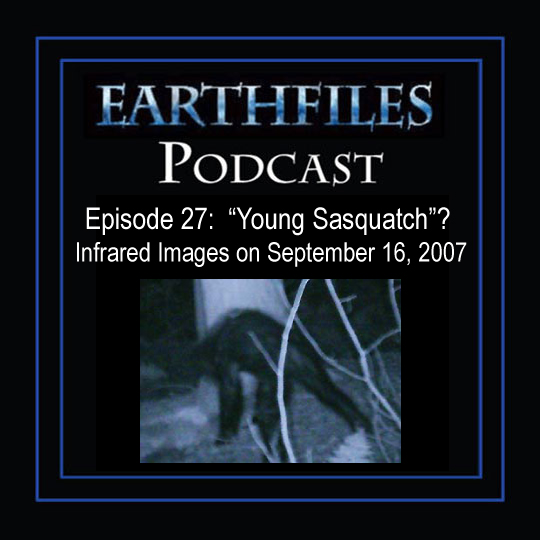
Episode 27 – “Young Sasquatch”? Infrared Images on September 16, 2007

Play

Episode 27 - "Young Sasquatch"? Infrared Images on September 16, 2007In mid-September 2007, deer hunter, R. Jacobs, was not thinking about Sasquatch/Bigfoot when he placed a deer mineral lick and deer-attracting scents where he set up his Bushnell game trail camera in northwestern Pennsylvania. All he wanted to know was how many deer – especially big bucks – were using the trail so he could plan his deer hunt. The location is three hours north of Pittsburgh in very remote forest. Mr. Jacobs’ camera automatically senses light and can take color photos in daytime – then switch to infrared at night – with or without flash. The camera was set to go off at motion in front of the lens. On September 16, 2007, between 8:04 PM and 8:32 PM, two young black bears were caught on an infrared image, followed by a hairy, primate-looking creature in two different postures that the Bigfoot Field Researchers Organization (BFRO) is calling a “juvenile Sasquatch.”

episode 27